

You felt wonderfully relaxed after acupuncture. Then you reached for your seat belt, and there was that same shoulder pain.
Relaxation can be a welcome part of treatment. But when a particular movement keeps hurting, you want to understand what is happening in that shoulder and what your treatment is doing about it.
That is where the orthopedic approach becomes especially useful. It brings the relationship between muscles, joints, nerves, and movement to the center of your acupuncture care.
The short answer: Orthopedic acupuncture combines acupuncture with a focused assessment of the structures and movement patterns involved in pain. That assessment helps guide point selection, supporting therapies, and the way progress is checked. It can sit comfortably alongside traditional acupuncture and your existing medical care.
The difference starts before the first needle
Traditional acupuncture can address a wide range of concerns, including pain, sleep, stress, and digestion. Practitioners may use traditional Chinese medicine patterns to understand how those concerns fit together and choose treatment accordingly. The NCCIH guide to acupuncture’s effectiveness and safety offers an overview of the research across different conditions.
Orthopedic acupuncture gives particular attention to a more specific question: which muscles, joints, or nerve pathways may be contributing to this pain or movement problem? Your history and physical assessment help shape the answer.
These approaches overlap. Traditional acupuncture is not simply a relaxation treatment, and an orthopedic approach still considers the person attached to the painful shoulder. The distinction is the emphasis on musculoskeletal assessment and how those findings guide care.
For you, that means the appointment may include a closer look at how you move, where you feel restricted, and what happens when a particular area is examined. The treatment has a specific problem to work on and a practical way to check whether it is helping.
The painful spot is a clue, not the whole story
Your knee hurts on the stairs, so naturally you point to your knee. But the way your hip moves or how you load that leg may also matter. A tingling sensation in your hand may call for attention to the neck or shoulder as well as the hand itself.
Those are possibilities to investigate, not conclusions you can draw from a symptom alone. The value of assessment is in looking for the pattern that fits your particular situation.

It also helps explain why treating only the place that hurts can sometimes leave you frustrated. A sore spot may be part of a larger movement problem, especially when an old injury has changed how you stand, walk, or reach.
If that sounds familiar, our article on why old injuries can start hurting years later explores that connection further. You do not need to figure out every contributing factor before you ask for help.
What a focused assessment can look like
The first useful information is often something you already know: when the problem started, what makes it worse, and what you have stopped doing because of it. Details like “I can walk, but getting out of the car hurts” tell us more than a pain score alone.
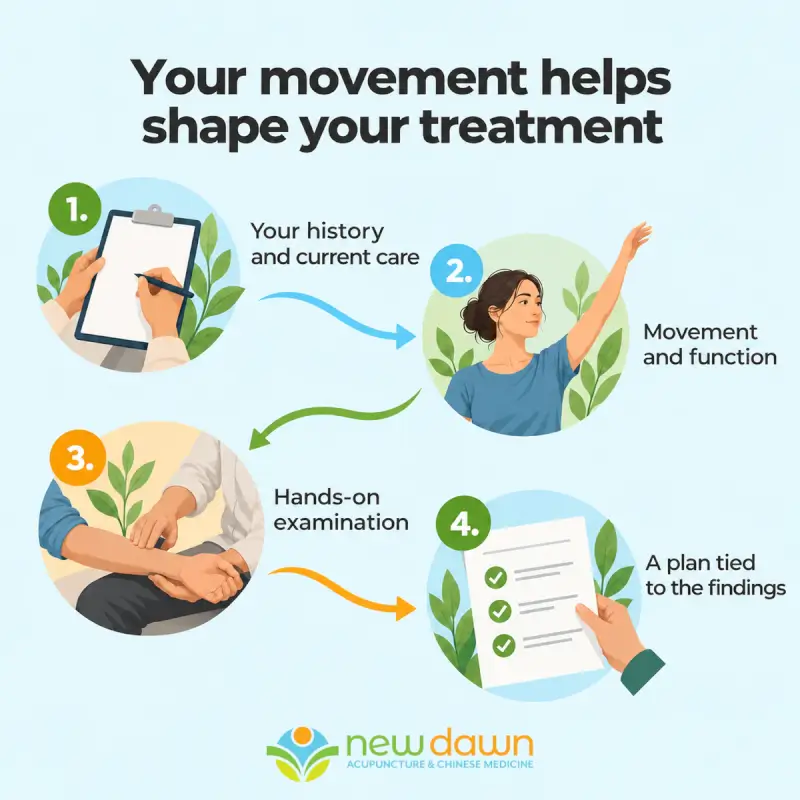
A focused visit may include:
- A review of your history and current care. Previous injuries, procedures, diagnoses, medications, and treatments help put the present problem in context.
- A look at movement and function. How you reach, turn, bend, or bear weight can help identify what is limited and give us something specific to reassess.
- Hands-on examination. Palpation means examining tissues by touch to locate tenderness, tension, and other findings relevant to your symptoms.
- A treatment plan tied to those findings. Point selection and any supporting techniques are chosen for the problem being addressed, then adjusted as your response becomes clearer.
This is still acupuncture care. It does not replace imaging, an orthopedic diagnosis, or other medical evaluation when those are needed. It makes the acupuncture treatment more closely connected to what your body is doing and what you want it to do comfortably again. If rehabilitation is also part of your plan, our guide explains how acupuncture and physical therapy can work together.
Precise treatment can still care for the whole person
Pain rarely stays neatly in one corner of your life. A shoulder that wakes you at night can leave you tired and tense the next day; a knee that limits walking can make you feel less independent.
An orthopedic focus does not require ignoring those effects. We can pay attention to the mechanics of a painful area while also considering sleep, stress, and the demands you place on your body every day. The review Acupuncture as Part of Multimodal Analgesia for Chronic Pain explores acupuncture’s place among the different approaches used to manage ongoing pain.
At New Dawn, our approach brings traditional acupuncture together with modern tools and hands-on techniques when they fit the individual. Depending on your needs, that may include electrostimulation, photobiomodulation, or soft tissue work. There should be a reason for each part of your plan.
For chronic soft tissue pain, our FAST™ approach combines targeted acupuncture, cross-fiber manual therapy, and photobiomodulation. Orthopedic assessment helps inform care; FAST is a particular treatment approach we may discuss when it fits your condition.

Progress should show up in your day
A calmer hour on the treatment table can feel good. The more useful question is what changes when you go back to living your life.
Maybe you can turn your head more comfortably while driving. Maybe you can finish your usual walk, reach into a cupboard, or sleep on the side you have been avoiding. Those details help make progress visible.
Your treatment should respond to that information. If relief is brief, if a movement remains restricted, or if something new appears, that is part of the next conversation. We should be able to explain what we are watching, when we will reassess, and how that affects the plan.
At New Dawn, a clear plan includes the recommended number and frequency of treatments, costs, and realistic expectations. You should understand what you are committing to and what we hope to change together.
If you have tried acupuncture before, bring that experience with you
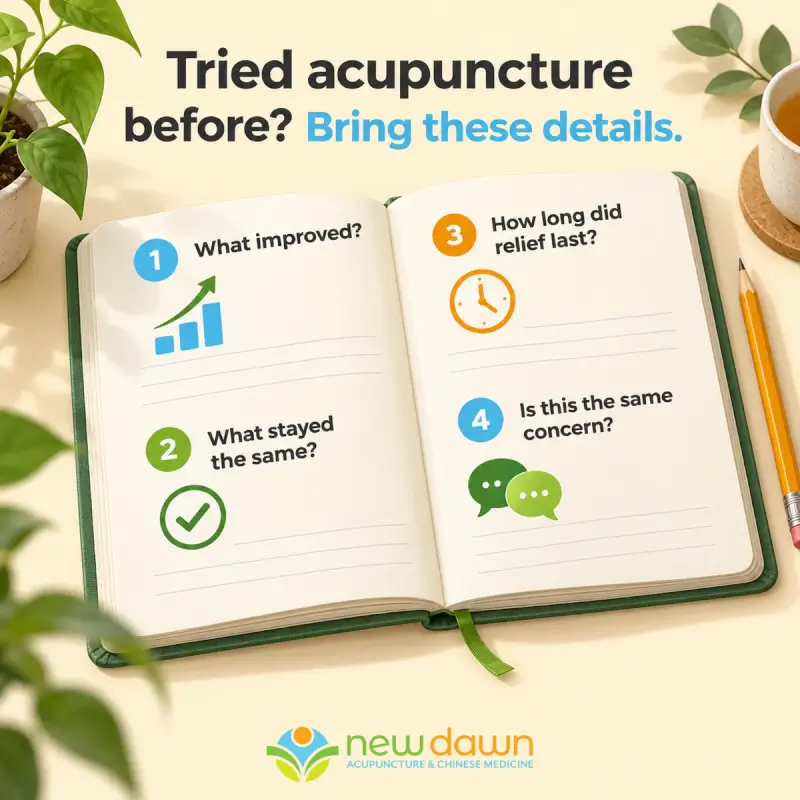
A previous course of acupuncture is useful information. Tell us what improved, what did not, how long any benefit lasted, and whether your original concern was the same one you have now.
An orthopedic assessment may offer a different way to approach a persistent movement problem. That does not promise a different outcome for everyone, but it gives us a more specific conversation than “acupuncture worked” or “acupuncture did not work.”
You also do not need to be an athlete to benefit from a movement-focused conversation. Carrying groceries, sitting through a workday, gardening, and getting up from the floor are meaningful goals too.
A few questions patients often ask
How is orthopedic acupuncture different from traditional acupuncture?
Orthopedic acupuncture emphasizes musculoskeletal anatomy, movement, and physical assessment to guide treatment for pain and functional problems. Traditional acupuncture can address a broader range of concerns using Chinese medicine principles. The two approaches can overlap within an individualized treatment plan.
What happens during an orthopedic acupuncture assessment?
Your practitioner reviews your history and symptoms, examines relevant movement and tissues, and connects those findings to your treatment goals. The assessment guides point selection and supporting therapies, and gives you a basis for checking progress over time.
Can orthopedic acupuncture help if I have tried acupuncture before?
It may offer a useful approach when your previous treatment did not fully address a specific pain or movement problem. Your earlier response helps inform the assessment, but results depend on your condition and individual circumstances.
Does orthopedic acupuncture replace physical therapy or medical care?
No. Orthopedic acupuncture can be part of a coordinated plan that includes medical care and rehabilitation. Continue your existing care, and discuss new or changing symptoms with the appropriate medical professional.
Let’s connect your treatment to what you want back
You should not have to settle for a vague explanation of your pain or a plan that never seems to change. I want to hear what has been happening, what you have already tried, and what getting better would let you do again.
If you are in Takoma Park, Silver Spring, Bethesda, Hyattsville, or Washington, DC, contact New Dawn Acupuncture or call (202) 538-3995. We can talk about whether our approach fits your situation and what a clear next step could look like.

Dawn Caudill, M.Ac., L.Ac., Dipl.
Founder of New Dawn Acupuncture and Chinese Medicine, Dawn brings more than 20 years of personal experience with acupuncture to her work. She combines traditional acupuncture with modern therapeutic tools to support relief and healing for chronic and acute health concerns in Takoma Park and the greater Washington, DC area.
Last Reviewed: October 12, 2026