

You haven’t thought about that old injury in years. Then one day, out of nowhere, it’s back like it never left.
Old injuries have a frustrating way of resurfacing at the worst possible time. An old ankle sprain. A shoulder strain from a decade ago. A back injury you were sure had healed. People are often surprised when the pain returns years later.
Here’s the reassuring part: there’s a real reason this happens, and a better way to treat it than waiting it out.
Quick answer: Old injuries come back because they never fully healed in the first place. Scar tissue, lingering muscle imbalances, compensation patterns, and a sensitized nervous system leave a “weak link” that holds up fine until age, stress, or activity tips it over. Lasting relief comes from finishing the healing your body started, which is what acupuncture combined with FAST laser therapy is built to do.
Dealing with a flaring old injury in Takoma Park, Silver Spring, Bethesda, or Washington, DC? Learn about our chronic pain approach, or call (202) 538-3995 to schedule a consultation.

Why Do Old Injuries Come Back?
The short answer: they never fully left.
The longer answer is that your body is great at compensating, but not always great at completely healing. Here’s what’s going on under the surface.
Incomplete healing (the number one reason)
When you get injured, your body runs a healing process, but that process isn’t always perfect. You feel “better” and you move on. Yet the tissue may not have fully healed, scar tissue may have formed, and strength and mobility may never have come all the way back.
The pain left. A weak link stayed.
Scar tissue and adhesions
Scar tissue is your body’s quick fix. It isn’t as flexible or functional as healthy tissue, and over time it can restrict movement, reduce circulation, and create tension in the surrounding muscles. Eventually, that restriction starts to hurt again.
Compensation patterns
Your body is adaptable. When one area is hurt, others quietly pick up the slack: different muscles, a slightly altered walk, a changed posture. Over months or years, those compensations overload other tissues, create new pain patterns, and can re-trigger the original injury site.
Aging and wear over time
As we age, collagen becomes less elastic, recovery slows down, and joints and tissues take on more wear. An old injury that felt “fine” at 25 may not hold up the same way at 40.
Nervous system memory
Your body remembers. After an injury, the nervous system can stay sensitized, which makes it easier for pain to return after even minor stress. It’s one reason an old injury can flare with no obvious new trigger.

How It Keeps Coming Back
The pattern usually looks like this: an injury happens, the pain improves while the root issue stays, the body compensates, stress builds over time, and the pain returns.
Then it repeats. Unless the underlying dysfunction is corrected, the body keeps replaying the same loop.
How Soft Tissue Is Built to Heal (in Three Phases)
To understand why an old injury comes back, it helps to know how soft tissue (the muscles, tendons, and ligaments behind most strains and aches) is actually supposed to heal. Western medical science describes three overlapping phases.
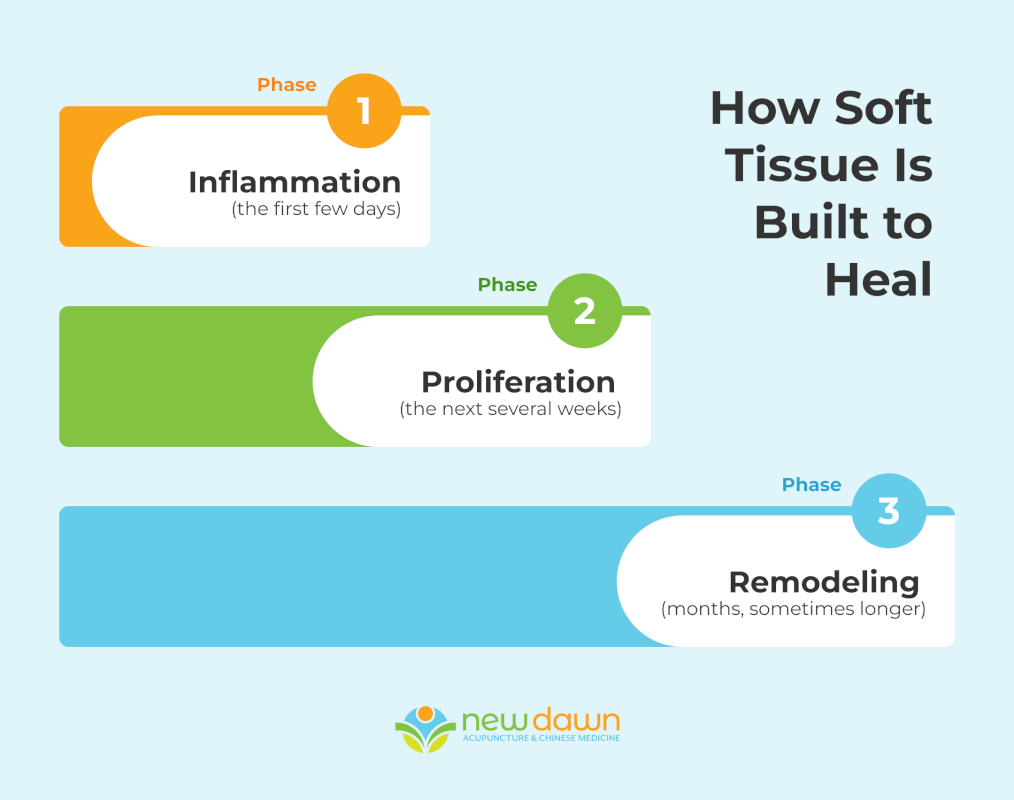
Phase 1: Inflammation (the first few days). Right after an injury, the area gets inflamed. That isn’t the enemy. Inflammation is how your body rushes in immune cells to clean up the damage and start repairs. It’s uncomfortable, but it’s the starting gun for healing.
Phase 2: Proliferation (the next several weeks). Your body lays down new tissue to patch the damage. This early tissue is essentially scar tissue: a fast, temporary fix that isn’t as strong, as flexible, or as well-supplied with blood as the original.
Phase 3: Remodeling (months, sometimes longer). This is the phase everyone forgets. Over months, that patchwork tissue is meant to reorganize and mature into strong, functional tissue, ideally stronger than it was before.
Here’s the catch:
If that final remodeling phase never fully finishes, you’re left with weak, scarred tissue instead of fully healed tissue. It looks fine. Once the pain quiets down, it even feels fine. But it’s a weak link, and a weak link is prone to re-injury and chronic pain down the road.
That’s the real story behind a lot of old injuries. They stalled out before Phase 3 ever finished.
Why the Standard Approach Often Backfires
Here’s the counterintuitive part. The standard response to a soft tissue injury, rest, ice, anti-inflammatory drugs, and sometimes a steroid injection, is designed to shut inflammation down. And shutting inflammation down is exactly what can keep an injury from finishing the job.
Remember, inflammation is Phase 1. It’s how healing begins. Suppress it, and you can interrupt the whole repair sequence before it ever reaches remodeling.
This isn’t just a theory.
A 2022 study in Science Translational Medicine found that blocking inflammation with anti-inflammatory drugs may actually lead to longer-lasting, harder-to-treat chronic pain. The researchers traced it to specific immune cells (neutrophils) that do essential early repair work, work that gets short-circuited when inflammation is suppressed.¹ In a separate analysis of about 500,000 people in the UK, those who used anti-inflammatory drugs for their pain were more likely to still have pain two to ten years later, an effect not seen in people taking acetaminophen.¹
The other standard tools carry their own trade-offs. Heavy icing and extended rest reduce blood flow to the very tissue that needs circulation to heal. Steroid injections can bring fast relief, then leave more scar tissue behind as that relief fades.
None of this makes these treatments useless. They have a place, especially for short-term comfort. But for a soft tissue injury, leaning on them can quietly trap the body in the early phases of healing and never reach full repair. You feel better, the injury goes quiet, and a weak, scarred spot is left behind, waiting to flare.
That’s how an acute injury becomes a chronic one. And it’s why an injury from years ago can still be unfinished business in your body today.
The Shift: Treating the Root Cause
To actually resolve an old injury, treatment has to restore proper movement, improve circulation, break up adhesions, calm the sensitized nervous system, and stimulate real tissue healing that turns protective scar tissue back into functional tissue.
That’s exactly where acupuncture, and the modern therapies layered with it, come in.
How Acupuncture Treats Old Injuries at the Root
Acupuncture works by activating your body’s natural repair systems.
It increases blood flow to old injury sites, helps break up scar tissue and adhesions, relaxes chronically tight muscles, reduces nerve sensitivity, and restores normal movement. Instead of masking symptoms, it helps your body finish the healing it started years ago. If you’re curious about the evidence, here’s why acupuncture works so well for pain relief, and the research behind it.
How FAST Differs From Acupuncture Alone
Acupuncture on its own is powerful. It restarts a stalled healing response, relaxes chronically tight muscles, improves circulation, and calms an over-sensitized nervous system. For many old injuries, that’s a real step forward.
But chronic, scarred tissue often needs more than a restart. It needs the scar tissue physically broken up, and it needs the repair that follows to be carried all the way through remodeling. That’s the gap FAST is built to close.
FAST (Functional Accelerated Soft Tissue) combines three things acupuncture alone doesn’t:
- Cross-fiber manual therapy to physically break down the scar tissue and adhesions left behind by the old injury.
- Targeted acupuncture to release tension, restart the healing response, and improve blood flow to the area.
- Photobiomodulation (laser therapy) to accelerate repair deep in the tissue at the cellular level, boosting cellular energy (ATP), calming inflammation, and supporting healthy collagen so the tissue rebuilds stronger instead of scarring further.
The difference shows up in the results. Acupuncture alone can take many sessions to make headway on a stubborn chronic injury, and the gains don’t always hold. By breaking up the scar tissue and then driving the tissue through to full remodeling, FAST is designed to heal chronic soft tissue injuries more completely, and in fewer visits. Here’s how photobiomodulation and acupuncture work together.
That’s why patients often recover more quickly, and more completely, than with acupuncture or standard care alone.
When Should You Seek Treatment?
If an old injury starts to “talk” again, don’t ignore it.
It’s worth getting care if you notice:
- Pain returning in a previously injured area
- Stiffness or reduced mobility
- Recurring flare-ups
- Pain triggered by activity, or even by rest
- Symptoms lasting more than a couple of weeks
The earlier you address it, the easier the cycle is to break.
Chronic Pain Treatment Near You
If you’re dealing with lingering or recurring pain in Takoma Park, Silver Spring, Bethesda, or Washington, DC, New Dawn Acupuncture offers a modern, results-driven approach built around healing the source, not masking it.
Ready to Finally Resolve That Old Injury?
If your pain keeps coming back, it isn’t random, and it isn’t something you have to live with.
New Dawn Acupuncture combines acupuncture with FAST laser therapy to help patients reach faster recovery, better outcomes, and relief that actually lasts.
Old injuries don’t have to be lifelong problems. But if one is speaking up again, that’s your cue to listen and get the right help.
Learn about our chronic pain care »
Schedule your consultation » or call (202) 538-3995.
References
- Parisien M, et al. “Acute inflammatory response via neutrophil activation protects against the development of chronic pain.” Science Translational Medicine, 2022 (McGill University). Blocking inflammation with anti-inflammatory drugs prolonged pain in mice, and a separate analysis of roughly 500,000 people in the UK linked anti-inflammatory use to a higher likelihood of pain two to ten years later. McGill Newsroom | Science Translational Medicine
- Three-phase model of soft tissue healing (inflammation, proliferation, remodeling): Gray’s Anatomy, 37th ed., as applied in the FAST Method (Steve Liu, L.Ac., “New Tools for Chronic Soft-Tissue Pain,” Acupuncture Today, 2022).