
If you’re dealing with pain, stiffness, or an injury that won’t fully quit, you’ve probably wondered: “Should I try acupuncture or physical therapy?”
It’s a fair question. And after years of treating patients in chronic pain, here’s the honest answer: it’s rarely either/or. Acupuncture and physical therapy address different parts of recovery, and in most cases they work better together.
Understanding why can help you stop guessing and start healing.
Quick answer: Physical therapy rebuilds strength and movement. Acupuncture reduces pain, calms the nervous system, and improves circulation so your body can actually heal. Combine them, and you recover faster – and more completely – than either alone.
Live in Takoma Park, Silver Spring, Bethesda, or Washington, DC? Learn about our approach, or call us at (202) 538-3995 to schedule a consultation.
What Is Physical Therapy?
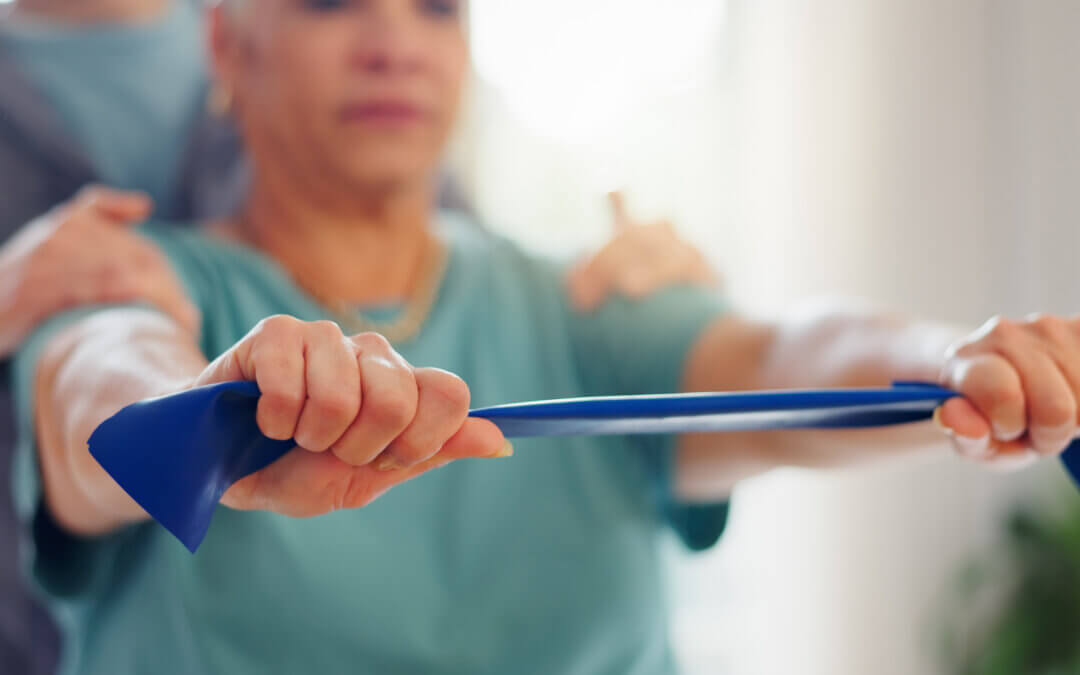
Physical therapy (PT) is the discipline of getting your body moving again, properly. A licensed PT looks at how you move, where you’re weak or guarded, and what’s holding back normal function, then coaches you through the work it takes to rebuild it.
Most PT plans include:
- Targeted exercises
- Stretching protocols
- Manual therapy
- Movement retraining
The goal: restore mobility and rebuild strength so your body can move and function normally again, and so the same injury doesn’t keep coming back.
What Is Acupuncture?
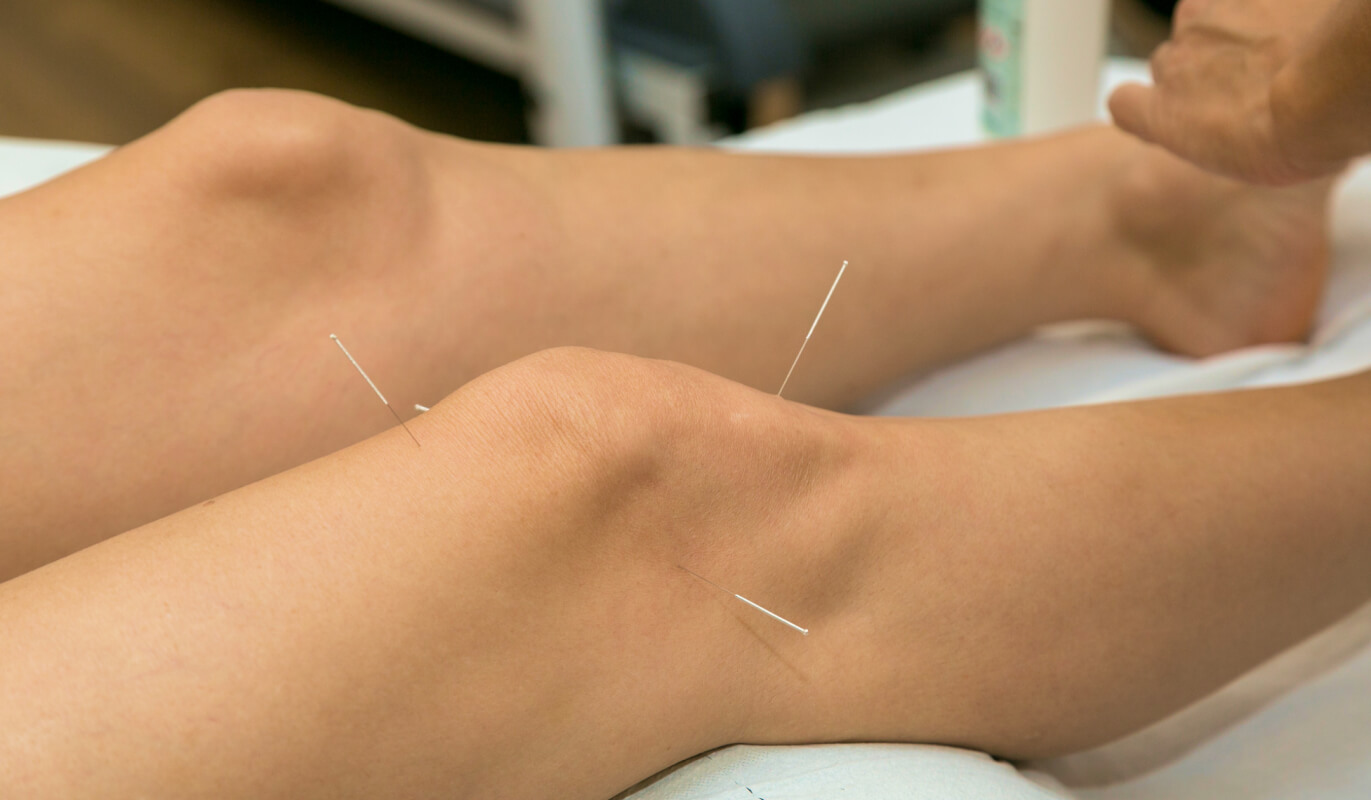
Acupuncture takes a different angle. Rather than working directly on muscles and joints through movement, it works on the body’s underlying systems (the nervous system, circulation, inflammation, and muscle tone) to create the conditions where real healing can happen.
By placing very fine needles at specific points, acupuncture works by:
- Stimulating the nervous system
- Improving circulation
- Reducing inflammation
- Releasing muscle tension
The goal: help your body heal, reset, and function better, so pain and dysfunction don’t keep coming back.

Where Physical Therapy Shines
PT is one of the most effective tools we have for restoring function. It’s especially powerful for the things you can’t fix by passively waiting things out.
Strength and stability. When weak or guarded muscles are part of the problem, PT rebuilds them and restores joint support. That’s what stops the same injury from recurring six months later.
Movement correction. When faulty movement patterns are involved (the way you compensate after a back injury, how you’ve been loading a knee), PT identifies and corrects them, which prevents the cascade of secondary problems that often piles on top of chronic pain.
Active recovery. Because PT involves you in your own healing, you walk away with more than relief. You walk away with the skills, strength, and habits that protect you long term.
Where Physical Therapy Hits Limits
PT is incredibly effective, but it has real challenges, especially when patients are in significant pain:
- Exercises can be painful or counterproductive when inflammation is high
- Progress is slow if your nervous system is too irritated to participate
- It doesn’t directly calm or reset the nervous system
- Tight, guarded muscles can limit how well you can do the work
- Results depend on you doing the home program consistently
When pain is high and the body is on high alert, even the best PT plan can stall. That’s not a failure of physical therapy. It’s usually a sign that the body needs something to clear the way first so the PT can land.
Where Acupuncture Shines
Acupuncture works differently, and it tends to shine in exactly the places PT often struggles.
Pain reduction. The most common thing patients notice is that pain drops, often within the first few sessions. Real, early relief, even when other approaches haven’t touched it.
Nervous system regulation. Acupuncture shifts the body out of a chronically activated fight-or-flight state and back into the parasympathetic (healing) mode where the body actually has the resources to repair itself.
Muscle relaxation. It releases deep tension and trigger points that have been locked in for weeks, months, or sometimes years.
Circulation and tissue healing. It improves blood flow to areas that have been quietly starved of it and supports tissue repair at the cellular level, a kind of healing you simply can’t reach with stretching alone.
Where Acupuncture Hits Limits
Acupuncture is powerful, but it isn’t the whole picture. On its own, it doesn’t build strength, retrain movement patterns, or correct the postural and biomechanical issues that may be driving your pain in the first place.
In other words, acupuncture can change how your body feels. PT changes how your body moves. For most chronic conditions, you really do need both.
Why They Work Better Together
Here’s where things get interesting.
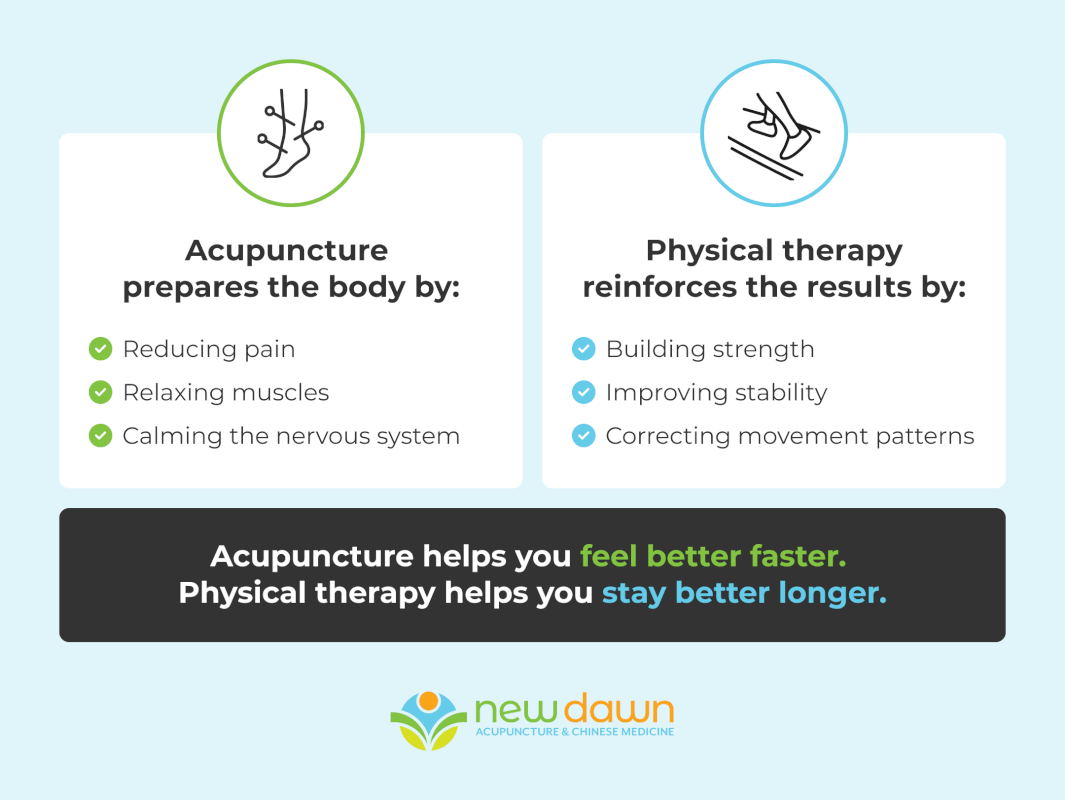
Acupuncture prepares the body by:
- Reducing pain
- Relaxing muscles
- Calming the nervous system
Once that shift happens, it’s dramatically easier to move, stretch, and strengthen without that fighting-your-own-body feeling. It also tends to make the gains from physical therapy hold longer, because the body isn’t constantly pulling itself back into the same protective patterns.
Physical therapy reinforces the results by:
- Building strength
- Improving stability
- Correcting movement patterns
In simple terms: acupuncture helps you feel better faster. Physical therapy helps you stay better longer.
This is also why patients sometimes hit a wall with PT alone, and why patients who only get acupuncture sometimes feel great but slip back into old patterns. The combination addresses both problems at once.
A Smarter Approach to Healing
At New Dawn Acupuncture, we don’t treat acupuncture as a stand-alone fix. Treatment focuses on helping your body recover efficiently, not just eventually.
We combine traditional acupuncture with modern tools, including our FAST™ method: a fascial and soft-tissue technique that uses photobiomodulation (low-level laser therapy) to:
- Reduce inflammation quickly
- Accelerate tissue healing
- Support nerve recovery
That creates the ideal environment for physical therapy to actually work the way it’s supposed to. (For one example of how this approach helps complex pain conditions, see our piece on acupuncture for neuropathy.)
When Should You Seek Help?
You don’t need to choose one or the other right away. But you also don’t need to wait until things get worse, and most of the patients who come in saying “I wish I’d come sooner” really mean it.
Consider care if you have:
- Pain that isn’t improving
- Limited movement or stiffness
- Recurring injuries
- Difficulty exercising because of discomfort
- Slow recovery from an injury or surgery
Early intervention almost always means faster progress and fewer setbacks. The longer the body stays guarded, the more it adapts around the problem, and the more there is to unwind later.
So… Acupuncture or Physical Therapy?
The real answer:
- Physical therapy for structure, strength, and movement
- Acupuncture for regulation, pain relief, and healing
- Together? A much more complete recovery plan
If you’ve been frustrated by partial results, or you’ve been told to “just keep doing the exercises” while your pain doesn’t budge, it might not be that PT is failing. It might be that your body needs something to clear the way first.
Ready to Recover Smarter, Not Slower?
Getting better shouldn’t be a guessing game. It should be a strategy.
If you’re tired of choosing between options, or not getting the results you want, it may be time for a more integrated approach. At New Dawn Acupuncture in Takoma Park, MD, we serve patients across Silver Spring, Bethesda, Hyattsville, Langley Park, and Washington, DC with clear treatment plans, modern techniques, and the goal of real, lasting results.
Learn more about our approach »
Schedule your consultation » or call (202) 538-3995.