

The honest truth is that anyone who promises a flat number of sessions before they’ve actually assessed you is either guessing or oversimplifying.
Here’s a clear, honest breakdown of what to expect, with no fluff and no “you’ll be fixed in one session” promises.
Quick answer: Acute issues (recent injuries, tweaks, short-term pain) usually resolve in 3-6 treatments. Chronic issues (months or years in the making) typically take 6-12+ treatments, sometimes more. The exact number depends on the condition, your history, and how your body responds. Maintenance care after the initial series is optional but often worth it.
Live in Takoma Park, Silver Spring, Bethesda, or Washington, DC? Learn about our approach, or call us at (202) 538-3995 to schedule a consultation.
The Biggest Factor: Acute vs. Chronic
This is the single most important difference, and it’s where most patients get the count wrong by a lot.
Acute conditions (short-term issues)
Think recent stuff. You slept wrong. You tweaked your back picking up a kid. You pulled a muscle, or you have a recent injury that hasn’t had time to settle in yet.
What to expect:
- Fewer treatments overall
- A faster response, often in the first session or two
- Noticeable improvement within the first few sessions
Typical range: 3-6 treatments.
Why so quick? Because the issue is recent, less ingrained, and your body hasn’t built long-term compensation patterns around it yet. The system can resolve and move on.
Chronic conditions (long-term issues)
Think pain that’s been there for months or years, recurring problems, old injuries that keep coming back, ongoing stress or anxiety patterns, and the layered conditions that have been quietly building for a long time.
What to expect:
- More gradual progress
- A series of treatments, not a one-off
- Deeper, system-wide changes that take time to take hold
Typical range: 6-12+ treatments, sometimes more depending on complexity.
Why longer? Because chronic conditions involve compensation patterns, nervous system adaptation, slower tissue healing, and multiple systems at once – muscles, nerves, circulation. Your body has to unlearn old patterns and rebuild new ones, and that doesn’t happen in three visits.
It Also Depends on the Condition
Not all issues are created equal. Muscle tension often responds quickly. Nerve issues take longer to heal because nerves regenerate slowly. Internal or systemic issues require consistency over time. That’s why treatment plans are individualized rather than one-size-fits-all – what works in 4 sessions for one patient might reasonably take 10 for another, even with the same diagnosis on paper.
The “You’ll Know It’s Working” Phase
Most patients notice some kind of shift early on:
- Pain decreases
- Sleep improves
- Stress levels drop
- Movement feels easier
- Range of motion increases
Here’s the key, though: feeling better doesn’t mean fully healed. Stopping at the first sign of relief is one of the biggest reasons problems come back, especially with chronic conditions. The early shift is the body responding. The full recovery is the body finishing the work.
Why Maintenance Care Is Sometimes Needed
Let’s be real: life doesn’t stop stressing your body just because you had acupuncture. Job stress comes back. Sleep slips. The same desk and the same commute keep loading the same patterns into your shoulders.
Maintenance care helps prevent flare-ups, keeps the nervous system regulated, and supports long-term healing. For most patients it looks like occasional treatments, monthly sessions, or seasonal “tune-ups” – not because something is wrong, but because you’re keeping things right. It’s the same logic as exercising consistently rather than only when you’re injured.
Why Typical Treatments Often Fall Short
A lot of people try a familiar mix: pain medication, rest, occasional therapy. Those can absolutely help in the short term. But they tend to focus on symptoms rather than root causes, and they don’t always support long-term healing. That’s why issues so often improve, disappear for a stretch, and then come back.
The aim of an actual treatment plan is to break that cycle, not just patch over it.
A Better Way to Think About Treatment
Acupuncture isn’t just about getting rid of pain. It’s about restoring balance, improving function, and helping your body heal properly so the same problem doesn’t keep returning.
That process takes the right treatment, the right frequency, and enough time to actually complete the job. Skip any of those and you’ll feel some short-term relief, but the underlying pattern will still be there waiting.
When Should You Seek Treatment?
You don’t have to wait until things are unbearable. Earlier treatment usually means fewer sessions and faster results, because the body hasn’t had as much time to compensate around the problem.
Consider acupuncture if you have:
- Pain that isn’t going away
- Recurring issues
- Stress or anxiety
- Poor sleep
- A general sense your body is “off”
If you’re in Takoma Park, Silver Spring, Bethesda, or Washington, DC, New Dawn Acupuncture builds personalized treatment plans based on your specific condition and goals – not a generic schedule.
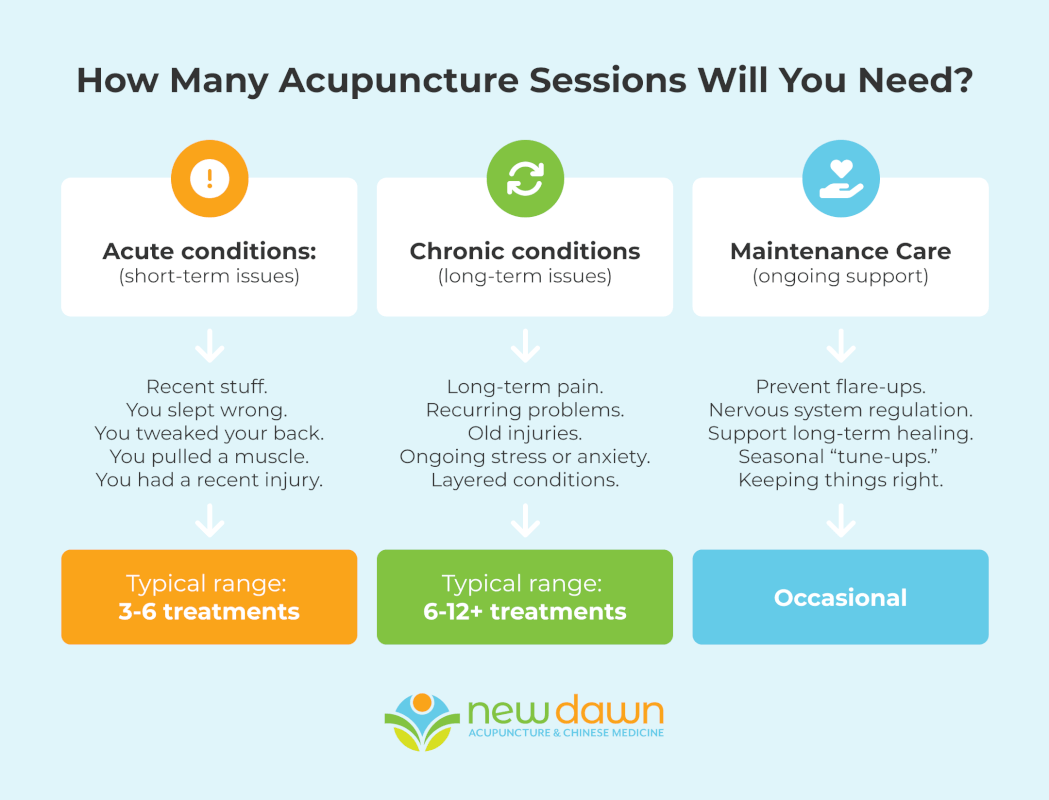
So… How Many Treatments Do You Need?
The honest answer:
- Acute issue – a handful of treatments, typically 3-6.
- Chronic issue – a series of treatments, typically 6-12+.
- Long-term health – occasional maintenance care.
No shortcuts, no gimmicks, no “fixed in one session” promises. Just a process that works with your body, not against it.
Ready to Get the Real Answer for Your Body?
The number of treatments you actually need isn’t a guess. It’s something we determine based on your specific condition, your goals, and how your body responds in the first few sessions.
Learn more about our approach »
Schedule your consultation » or call (202) 538-3995.
Because the goal isn’t just to feel better for a week. It’s to get better, and stay that way.