
Anxiety isn’t just “in your head.” If it were, your shoulders wouldn’t feel like concrete, your heart wouldn’t race at 2 a.m., and your stomach wouldn’t flip over before a normal day.
Anxiety is a full-body experience, and treating it effectively means addressing all three levels at once: physical, mental, and emotional. There are real approaches that go beyond “just coping,” and they don’t promise unrealistic quick fixes. They focus on the system, not just the symptoms.
Quick answer: Anxiety is your nervous system stuck in “on” mode. The fastest path to relief isn’t fighting symptoms one by one; it’s helping the system regulate, so the symptoms naturally settle. Acupuncture works on that regulation directly.
Live in Takoma Park, Silver Spring, Bethesda, or Washington, DC? Learn about our approach to anxiety, or call us at (202) 538-3995 to schedule a consultation.
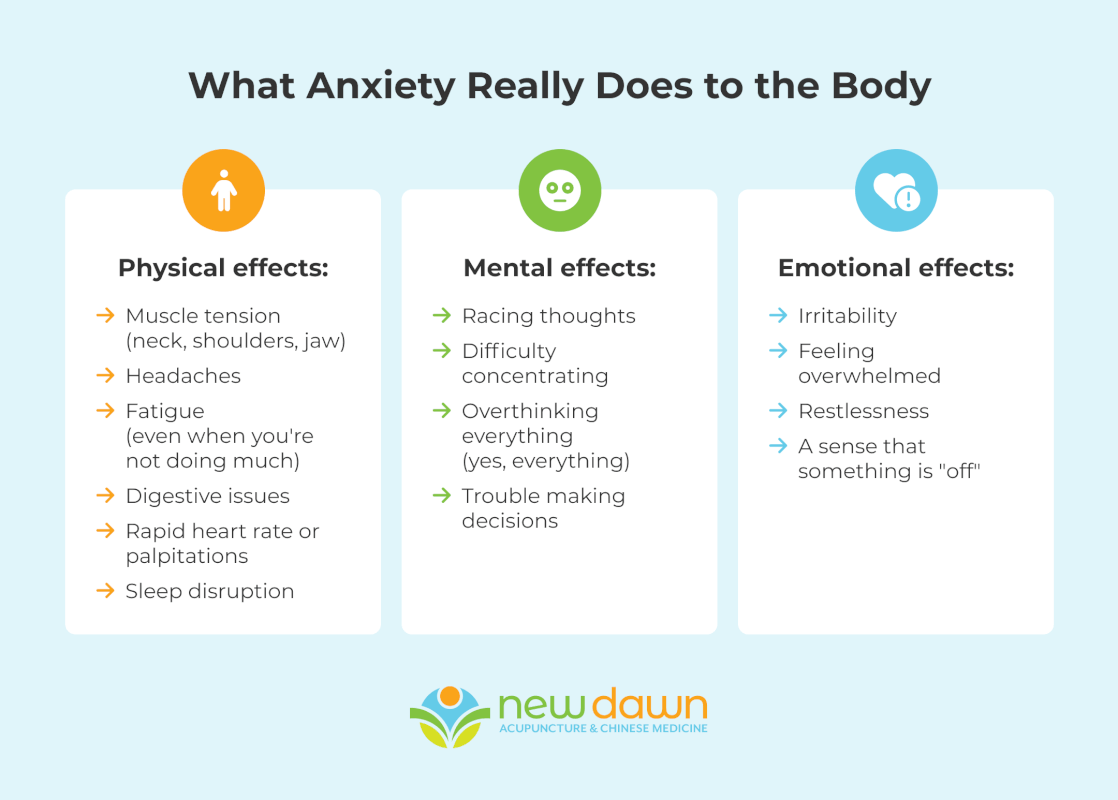
What Anxiety Really Does to the Body
Anxiety is your nervous system stuck in “on” mode. When that happens, your body maintains a prolonged stress response, often called fight-or-flight. It was built for short bursts. When it stays on for weeks or months, it starts producing the symptoms patients show up describing, and those symptoms tend to cluster across three layers.
Physical effects:
- Muscle tension (neck, shoulders, jaw)
- Headaches
- Fatigue (even when you’re not doing much)
- Digestive issues
- Rapid heart rate or palpitations
- Sleep disruption
Mental effects:
- Racing thoughts
- Difficulty concentrating
- Overthinking everything (yes, everything)
- Trouble making decisions
Emotional effects:
- Irritability
- Feeling overwhelmed
- Restlessness
- A sense that something is “off”
In other words, anxiety doesn’t stay in one lane. It spreads across your entire system, which is exactly why an approach that targets only one lane tends to feel partial.
What Causes Anxiety?
There’s rarely just one cause. Anxiety usually builds from a stack of factors that compound on each other:
- Chronic stress. Work, life, responsibilities. Your brain doesn’t always get the memo when a “threat” is over, so the alarm system stays armed.
- Nervous system dysregulation. The body becomes conditioned to stay in a heightened state of alertness, even when nothing immediate is happening.
- Sleep disruption. Poor sleep increases stress hormones, which in turn worsens anxiety. It’s a feedback loop, not a single problem.
- Physical tension patterns. Chronic muscle tightness sends signals back to the nervous system, reinforcing the “stay on alert” message.
- Past experiences. Previous stress or trauma can make the nervous system more reactive over time, even after the events are long gone.
When several of these are running at once, addressing only one of them rarely settles the whole picture.
Why Typical Treatments Can Fall Short
Conventional approaches, especially medications, can absolutely help some people. But they’re a piece of the puzzle, not the whole picture, and it’s worth being honest about where they hit limits.
Medications: helpful but limited. They can reduce symptom intensity and change how the brain processes stress signals. What they often don’t do is address the underlying nervous-system patterns that keep producing the anxiety in the first place. Side effects vary, individual response varies, and long-term use is its own conversation with a prescribing provider.
The bigger issue. Many treatments focus on managing symptoms rather than helping the body return to a more balanced baseline. That’s why so many people end up cycling through coping strategies, supplements, and apps without the anxiety actually shifting at the root.
A More Realistic Approach to Anxiety Care
Let’s be clear: this isn’t about overnight fixes. Effective anxiety treatment takes time, often involves multiple approaches, and may require ongoing maintenance.
The goal isn’t perfection. It’s regulation. We’re helping your body shift from constant “alert” mode to a more stable, calm state, and then helping that state hold over time. 
How Acupuncture Helps Treat Anxiety at the Root
Acupuncture works directly with the nervous system, which is exactly where anxiety lives. By stimulating specific points, treatment helps:
- Calm the stress response
- Regulate the autonomic nervous system
- Reduce muscle tension that feeds back into the loop
- Improve sleep quality
- Promote natural relaxation responses
Many patients describe it as their body finally being allowed to exhale. Instead of forcing calm with willpower, acupuncture helps your system relearn it.
Why This Matters for Physical, Mental, and Emotional Health
Because everything is connected. When the nervous system calms, muscles relax. When muscles relax, pain decreases. When pain decreases, stress lowers. When stress lowers, mental clarity improves. It isn’t separate systems running in parallel.
It’s one integrated loop. Treat the loop, and the symptoms across all three layers begin to shift together.
When Should You Seek Treatment?
You don’t have to wait until anxiety becomes overwhelming. Consider seeking help if you experience:
- Persistent worry or racing thoughts
- Physical tension that won’t go away
- Prolonged difficulty sleeping
- Feeling constantly “on edge”
- Anxiety that interferes with work, relationships, or daily life
Early support can make a meaningful difference in how anxiety develops over time. The longer the nervous system stays in alert mode, the more the body adapts around it, and the more there is to unwind later.
If you’re navigating anxiety in Takoma Park, Silver Spring, Bethesda, or Washington, DC, New Dawn Acupuncture offers a grounded, realistic, whole-body approach.
Ready to Take the Next Step?
If anxiety is affecting your body, your mind, or your day-to-day life, it may be time to move beyond just managing symptoms. Acupuncture supports your nervous system rather than fighting it, helping you move toward a more balanced state over time. You don’t have to feel “on” all the time, and you don’t have to figure it out alone.
Learn about our anxiety care »
Schedule your consultation » or call (202) 538-3995.