

You trust your doctor. You are following the treatment plan. And you would still really like to get through dinner without nausea, sleep more comfortably, or have a day that feels less organized around pain.
Wanting more support does not mean you have lost faith in your medical care. It means the day-to-day experience of getting through treatment matters, too.
Acupuncture can have a useful place in that picture. Your doctor stays your doctor, your prescribed treatment stays in place, and we look at whether acupuncture could help with the symptoms making life harder along the way.
The short answer: Complementary acupuncture is used alongside conventional medical care to help manage selected symptoms, such as pain or treatment-related nausea. It does not replace diagnosis, medication, surgery, or cancer treatment. The most useful plan starts with a specific goal and keeps your providers informed.
You do not have to choose a side
The words “alternative” and “complementary” often get used as if they mean the same thing. They describe very different decisions.
Alternative care replaces conventional treatment. Complementary care is added to it. Integrative care brings conventional and complementary approaches together in a coordinated plan, as explained by the National Center for Complementary and Integrative Health.
For example, someone receiving chemotherapy might discuss acupuncture with their oncology team to help manage nausea while continuing cancer treatment. Someone living with knee osteoarthritis might explore acupuncture as one part of a plan that also includes medical care and appropriate exercise.
The question becomes more practical: what symptom needs attention, and what could safely help? You can be fully committed to your medical treatment and still ask that question.
The treatment plan is one part of the experience
A diagnosis can come with a calendar full of appointments, instructions to remember, and decisions you never expected to make. Meanwhile, there is still a person trying to eat, work, sleep, and spend time with the people they love.
Conventional care addresses disease and symptoms through testing, medication, procedures, rehabilitation, and other treatments. Even with good care in place, some symptoms may remain difficult to manage.
That is where a conversation about complementary support can be worthwhile. It might begin with pain that is interrupting sleep, nausea that makes meals difficult, or the physical tension that comes with an exhausting stretch of treatment.
We start with what is affecting you most. A useful goal might be eating more comfortably or getting through an everyday activity with less pain. “Feel better” becomes much easier to work toward when we understand what better would actually look like for you.
Cancer care shows why “alongside” matters
Acupuncture has been studied extensively as supportive care in oncology. The focus is on symptoms and the effects of treatment, rather than using acupuncture to treat the cancer itself.
The National Cancer Institute’s patient guide describes research on treatment-related nausea and vomiting, pain, and other symptoms. Results vary by symptom and study, so the conversation should stay specific to your situation.
The NCCIH overview of cancer and complementary care reports a 2020 analysis of 14 studies involving 920 participants that associated acupuncture with reductions in cancer pain. It also describes evidence supporting acupuncture for treatment-related nausea and vomiting. These findings support a discussion about symptom management, not a guarantee of benefit for every person.
If you are receiving cancer treatment, your oncology team should be part of the decision before you begin. Your treatment schedule and current health can affect whether acupuncture is appropriate and how it should be adapted.
At New Dawn, our cancer support approach considers what you are experiencing and what your body can comfortably tolerate. The aim is to help you feel more supported through treatment and recovery while your oncology care continues.
The same principle applies beyond cancer treatment
You do not need a cancer diagnosis to want a more complete approach to persistent symptoms. People managing chronic conditions or recovering from surgery may also want help with pain, tension, and the strain those symptoms put on daily life.
Acupuncture has been studied for conditions including knee osteoarthritis, low back pain, and neck pain. The NCCIH acupuncture overview describes the evidence and its limits across different conditions. That broader research does not tell us exactly how you will respond, but it can inform a conversation about fit.
For an orthopedic problem, acupuncture may sit alongside a rehabilitation plan. If you are weighing those roles, our article on acupuncture and physical therapy explains how the approaches can work together.
Your existing care provides important context. A recent procedure, a change in medication, or a new symptom can all affect the next step, which is why we want the full picture before building a plan.
A coordinated plan starts with shared information
You should never feel as though you need to keep one provider a secret from another. Good complementary care works best when everyone understands what you are receiving and why.
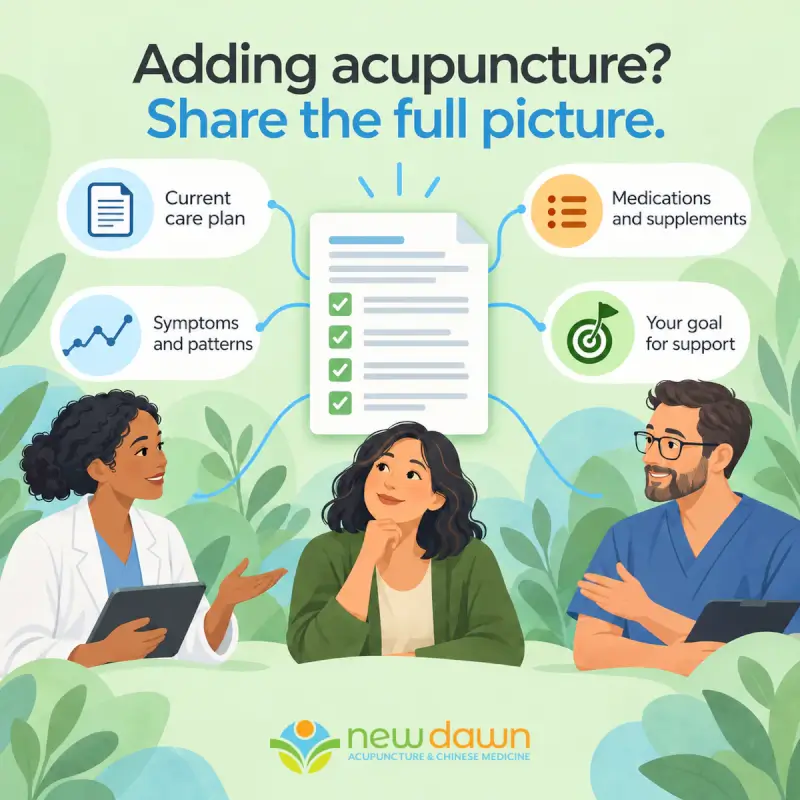
Before starting, bring the information that helps connect the pieces:
- Your current care plan. Share diagnoses, recent procedures, upcoming treatments, and any restrictions or guidance from your medical team.
- Your medications and supplements. Include prescriptions, over-the-counter medicines, herbs, and supplements so your providers have the same picture.
- Your main symptom and its pattern. Explain when it happens, what makes it harder, and how it affects eating, sleep, movement, or other daily activities.
- Your goal for additional support. Choose something concrete to track, such as the frequency of nausea or how comfortably you can complete a usual activity.
Then tell your medical provider you are considering acupuncture and ask whether any timing or precautions apply. In cancer care or after surgery, that conversation is especially useful before scheduling treatment.
If medication reduction becomes a goal, the prescribing clinician guides it. Feeling better after acupuncture is information to share with your doctor, not a reason to change a dose on your own.
More care should come with a clear purpose
Another appointment takes time, energy, and money. You deserve to understand what it is meant to help with, how often treatment is recommended, and when you will review the response.
At New Dawn, I want to hear what has been hardest and what you have already tried. We will discuss whether our approach makes sense for your situation, what the plan involves, and what improvement we will look for together.
That plan should respond to your experience. If something is not helping, or if your medical care changes, we need to know. Your treatment is a conversation that continues beyond the first visit.
Questions about combining acupuncture with medical care
Can I have acupuncture while continuing conventional medical treatment?
Acupuncture can be used alongside conventional care when it is appropriate for your condition and current treatment. Tell your medical provider and acupuncturist about all the care you receive, and discuss any timing or precautions before starting.
Is complementary acupuncture the same as alternative medicine?
No. Complementary acupuncture is added to conventional medical care. Alternative medicine replaces conventional treatment. A coordinated approach keeps appropriate medical treatment in place while considering additional support for specific symptoms.
Does acupuncture treat cancer itself?
No. Acupuncture may be considered for selected symptoms or treatment side effects, but it does not replace cancer-directed treatment. Discuss it with your oncology team before adding it to your care plan.
Should I stop taking medication if acupuncture helps?
No. Continue medication as prescribed unless your prescribing clinician changes the plan. Tell that clinician about any improvement, side effects, or concerns so medication decisions can be made with your full medical situation in mind.
You can ask for support and keep the care you trust
You do not have to arrive with a perfect plan for fitting everything together. Start with what has been difficult, what your doctors are treating, and what you would like to feel more capable of doing again.
If you are in Takoma Park, Silver Spring, Bethesda, Hyattsville, or Washington, DC, contact New Dawn Acupuncture or call (202) 538-3995. We will talk through whether acupuncture could be a useful part of your care and what the next step would involve.

Dawn Caudill, M.Ac., L.Ac., Dipl.
Founder of New Dawn Acupuncture and Chinese Medicine, Dawn brings more than 20 years of personal experience with acupuncture to her work. She combines traditional acupuncture with modern therapeutic tools to support relief and healing for chronic and acute health concerns in Takoma Park and the greater Washington, DC area.
Last Reviewed: October 21, 2026