
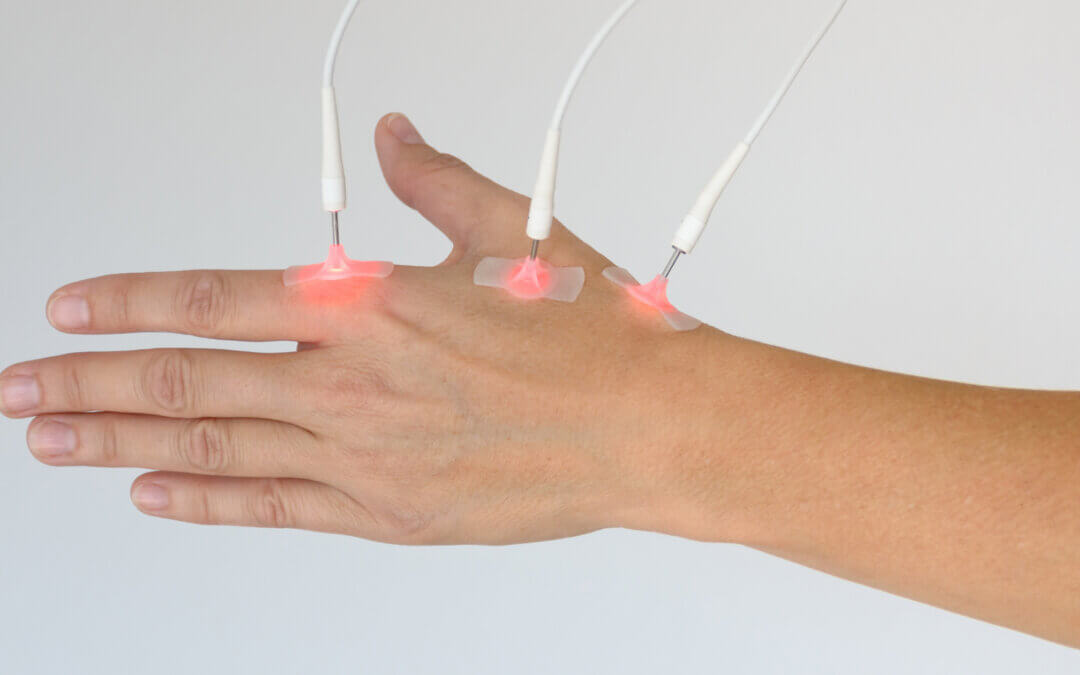
Imagine explaining this to someone 2,000 years ago: “We’re going to treat pain using tiny needles… and lasers.” They’d probably assume you were a wizard.
In fairness, photobiomodulation combined with acupuncture does sound a little magical. But behind the sci-fi name is a therapy that blends ancient Chinese medicine with modern light technology, and research suggests it may be part of the future of pain management and integrative medicine.
Let’s break down what it is, how it works, and why this combination is getting so much attention.
What Is Photobiomodulation?
Photobiomodulation (PBM) – formerly called low-level laser therapy (LLLT) – uses specific wavelengths of red or near-infrared light to stimulate cellular repair and reduce inflammation.
Instead of heating tissue like surgical lasers, PBM works at the cellular level. The light penetrates the skin and interacts with mitochondria (your cells’ energy factories). When mitochondria absorb this light, they produce more ATP, the molecule that powers cellular activity.
In simpler terms, light helps cells recharge their batteries.
The result can include
- Reduced inflammation
- Faster tissue healing
- Improved circulation
- Diminished pain signals (both in intensity and in frequency)
Now imagine combining that cellular boost with the nervous-system effects of acupuncture.
That’s where things get interesting.
How Photobiomodulation Enhances Acupuncture
Traditional acupuncture stimulates specific points on the body to regulate energy flow (Qi), reduce pain, and activate the nervous system.
When photobiomodulation is applied to acupuncture points (sometimes called laser acupuncture) it can amplify those effects.
Think of it as acupuncture with a technological upgrade.
Instead of metal needles alone, practitioners may use
- Laser stimulation on acupuncture points
- Light therapy applied along meridians
- PBM used alongside traditional needle treatment
The combination can enhance several biological mechanisms.
1. Stronger Anti-Inflammatory Effects
Acupuncture already reduces inflammatory markers in the body. PBM has also been shown to decrease inflammation by influencing cytokine activity. (Cytokines are proteins used by our immune system to generate an immune response.) Together, acupuncture and photobiomodulation can create a synergistic anti-inflammatory response.
2. Enhanced Nerve Modulation
Acupuncture stimulates sensory nerves that influence the brain’s pain-processing centers. PBM can further support nerve repair and regeneration, making the pair especially promising for neuropathic pain conditions, including things like peripheral neuropathy.
3. Faster Tissue Healing
Athletes and physical therapists often use PBM for muscle recovery. When combined with acupuncture’s ability to improve circulation and relax muscle tissue, healing may occur faster.
What the Research Shows
Scientific interest in photobiomodulation and acupuncture therapy has grown significantly in recent years.
A 2020 systematic review in Lasers in Medical Science found that laser acupuncture demonstrated significant pain reduction in musculoskeletal conditions, including neck pain and knee osteoarthritis, compared with placebo treatments.
Research published in Photomedicine and Laser Surgery reported that laser stimulation of acupuncture points can activate similar neural pathways as needle acupuncture, producing measurable changes in brain activity related to pain modulation.
Another review examining photobiomodulation therapies found clinical improvement rates ranging from 70% to over 85% in certain chronic pain conditions, particularly when PBM was used alongside other therapies such as acupuncture.
Researchers also note that PBM has an excellent safety profile, with minimal side effects when used appropriately.
Translation: the science is catching up with what many integrative clinics are already seeing.
These findings align with what we see clinically when treatments are combined in a structured and individualized way.
You can learn more about how we design treatment plans to address the root cause, not just symptoms.
Why Photobiomodulation Could Be the Future of Medicine
Today’s healthcare is slowly moving toward integrative treatments—approaches that combine traditional wisdom with modern science.
Acupuncture brings thousands of years of clinical experience. Photobiomodulation brings precision technology and measurable biological mechanisms.
Put them together, and you get a therapy that is
- Noninvasive
- Drug-free
- Low risk
- Supported by growing research
Also, let’s be honest: light therapy just sounds cool. Medicine is heading toward treatments that involve lasers, energy, and activating your body’s natural healing systems. We might finally be living in the future we were promised.
No flying cars yet… but at least our acupuncture might glow a little.
If you’ve been dealing with pain that just isn’t going away, or something that keeps coming back, it might be time to try a different approach.
We use a combination of therapies like this every day to help people move better and feel better.
If you’re curious whether it could help you, you can contact us here.